

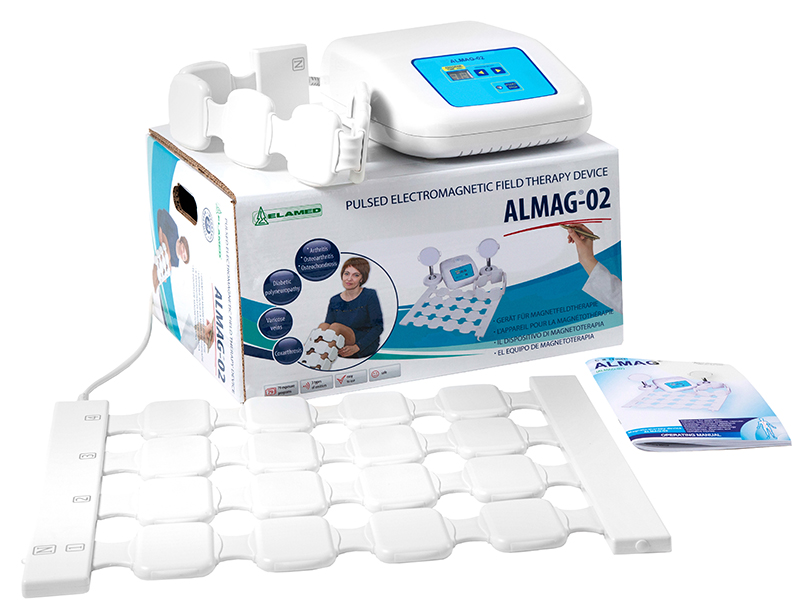
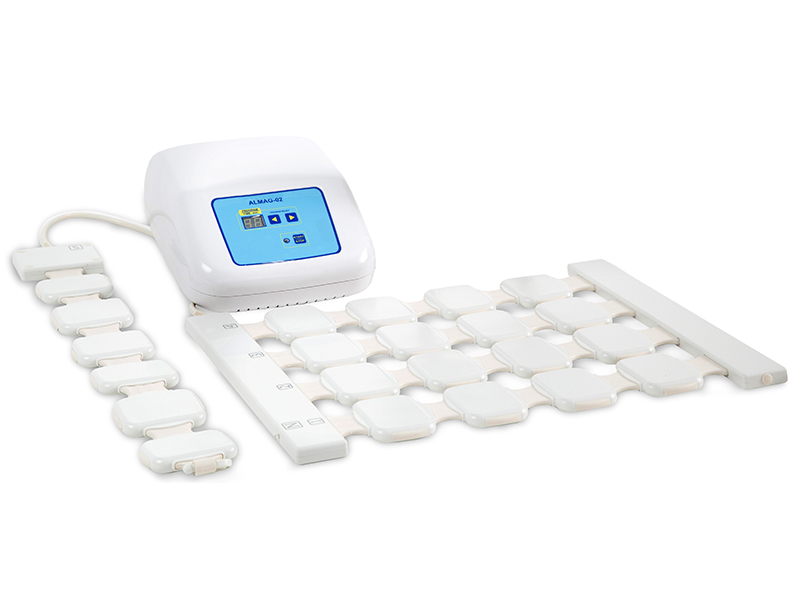
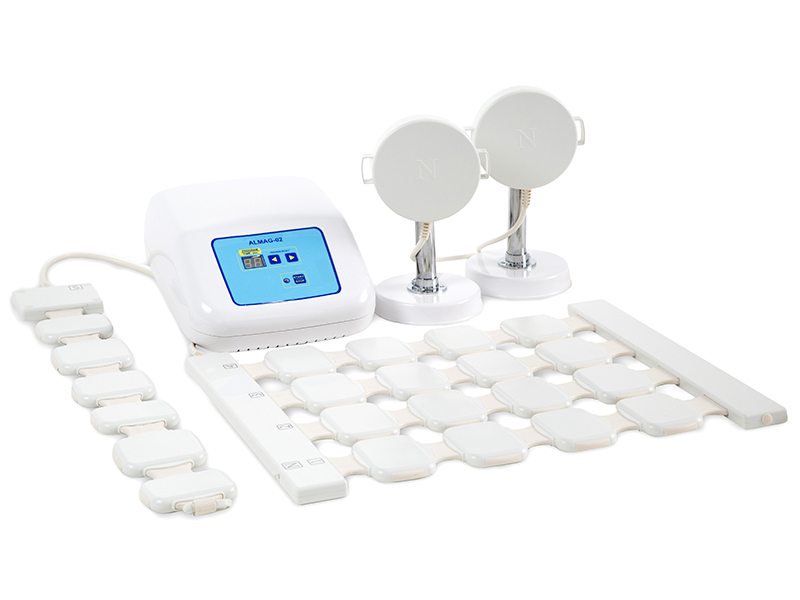
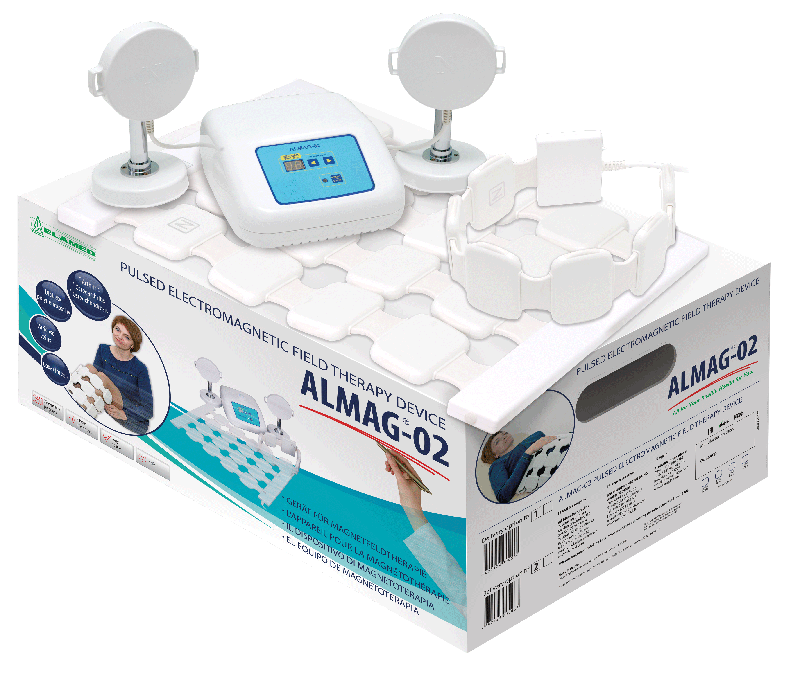
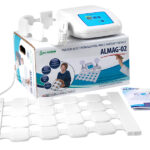
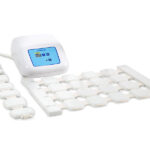
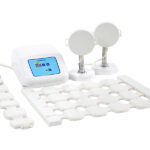
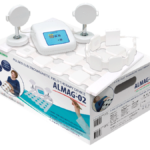
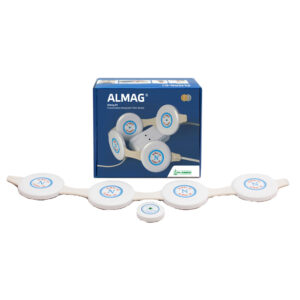
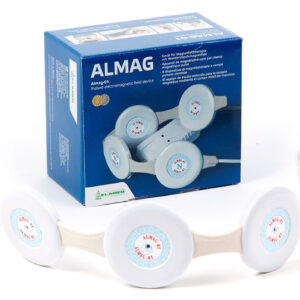
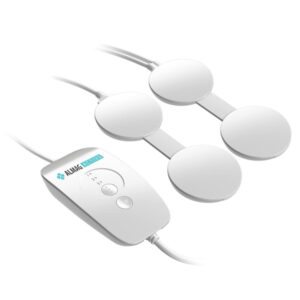
ALMAG-02 is distinguished by increased depth of magnetic pulse penetration. Different types of emitters allow to cover the required area or affect two zones at once.
ALMAG-02 can help:
- during recovery from pneumonia, including that caused by the COVID-19 virus*,
- for arthritis, arthrosis,
- in the treatment of varicose veins,
- in case of edema of vascular origin,
- in the treatment of chronic arterial insufficiency.
Reasons to choose ALMAG-02
- The device has 50 programs of action.
- The area and flexibility of the design allow to cover a wide area at once and provide a targeted and dense flow of magnetic radiation. Sufficient depth of penetration of the magnetic field of local emitters (up to 160 mm) makes it possible to treat a deep hip joint.
- ALMAG-02 helps to reduce the number of medications and prevent side effects.
- It can reduce treatment costs by almost half, helping to strengthen the treatment complex and maintain remission.
- Easy to use: clear instructions, one-click program launch, automatic shutdown, small dimensions and weight.
- It can help both as an independent remedy and as part of a treatment complex. It is especially relevant when other treatment methods are contraindicated.
Buy PEMF therapy device ALMAG®-02 and say goodbye to your chronic pain
PEMF devices use low-frequency, low-intensity electromagnetic impulses to treat the affected areas and restore the normal functioning of various internal organs. The multiple clinical tests have proven that ALMAG®-02 is effective as a supplementary treatment for patients both in a hospital and at home. The list of diseases that Portable PEMF therapy can help you manage includes but not limited to:
- Coxarthrosis
- Polyarthritis
- Atherosclerosis
- Vascular-related edemas
- Cystitis
- Varicose veins
To see the results, it is enough to use the device for at least thirty minutes a day.
What are the therapeutic effects of ALMAG®-02
The Russian Federation Ministry of Health has conducted numerous clinical trials of ALMAG®-02. As a result, it was proven that the pulsed electromagnetic field:
- recovers the cell membrane permeability;
- normalizes the diffusive and osmotic processes inside the cells;
- increases the speed of the enzymatic reaction;
- normalizes the transport properties of the biological membrane;
- accelerate the healing processes within the body;
- strengthens the immune system;
- tones the internal organs;
- increases performance efficiency;
- relieves pain;
- promotes good sleep;
- normalizes the mood swings;
- expands the capillary.
- To see the results, it is enough to use the device for at least thirty minutes a day.
Contraindications to the use of ALMAG-02.
- Bleeding and coagulopathy
- Systemic blood diseases
- Malignant neoplasms
- Severe cardiac arrhythmia (atrial fibrillation, paroxysmal tachyarrhythmia)
- Aneurysm of the heart, aorta and large vessels
- Acute period of myocardial infarction
- Acute period of ischemic and hemorrhagic stroke
- Purulent processes, active tuberculosis process, infectious diseases in the acute stage, febrile diseases
- Thyrotoxicosis
- Pregnancy
- Implanted pacemaker
Attention!
- Against the background of a course of chemotherapy and radiation therapy, the use of a pulsed magnetic field from the device is not contraindicated!
- The presence of stents or the condition after coronary artery bypass grafting is not a contraindication to treatment!
- The presence of titanium structures is not a contraindication to treatment!
Indications for use of ALMAG-02.
- Mental and behavioral disorders
- Neurocirculatory dystonia of the hypertensive type
- Diseases of the nervous system
- Migraine
- Transient cerebral ischemic attacks and related syndromes
- Lesions of individual nerve roots and plexuses of the upper and lower extremities
- Diseases of the radial, median, ulnar nerves
- With the development of paresis of the corresponding nerve
- Diseases of the femoral, sciatic, tibial and peroneal nerves
- Diabetic polyneuropathy
- Postherpetic neuropathy
- Raynaud’s syndrome (dead finger syndrome)
- Diseases of the circulatory system
- Hypertension
- Stable angina pectoris I-II FC
- Stroke
- Consequences of cerebrovascular diseases
- Atherosclerotic vascular disease, deforming or obliterating endarteritis
- Atherosclerotic (dyscirculatory) encephalopathy
- Varicose veins
- Deep vein thrombophlebitis of the leg
- Chronic lymphedema (lymphatic edema)
- Respiratory diseases
- Pneumonia viral
- Bacterial pneumonia
- Chronic bronchitis outside the acute stage
- Bronchial asthma and COPD
- Exudative pleurisy (after removal of fluid from the pleural cavity, three days after thoracentesis)
- Irritable bowel syndrome without diarrhea
- Alcoholic liver disease
- Chronic pancreatitis
- Coxarthrosis
- Gonarthrosis
- External (“tennis elbow”) and internal (“golfer’s elbow”) epicondylitis of the shoulder
- Acute trophoneurotic bone atrophy (Sudeck’s syndrome)
- Paratenonitis (crepitating tendovaginitis of the forearm)
- Osteochondropathies (Keller’s disease, Kienbock’s disease, Perthes’ disease, Schlatter’s disease, Koenig’s disease)
- Ankylosing spondylitis (Bechterew’s disease)
- Rheumatoid arthritis (exudative stage)
- Osteoarthritis
- Osteochondrosis of the spine
- Posterior cervical sympathetic syndrome
- Vertebrobasilar syndrome (vertebral artery reflex compression syndrome)
- Vertebrogenic myelopathy syndrome
- Osteoporosis with and without pathological fracture
- Diseases of the genitourinary system
- Chronic tubulointerstitial nephritis
- (Tubulointerstitial and tubular lesions induced by drugs and heavy metals)
- Bursitis, including after surgical treatment (on the 3rd day after surgery)
- Injury
- Joint dislocation
- Elbow and Forearm Injuries
- Dislocation, stretching and overstrain of the capsular-ligamentous apparatus of the elbow joint
- Dislocation of the radial head
- Traumatic rupture of the radial collateral ligament
- Stretching and straining of the capsular-ligamentous apparatus of the elbow joint
- Injuries to the coccyx, hip and thigh area
- Hip joint contusion
- Hip contusion
- Knee and shin injuries
- Contusion of other specified and unspecified part of leg
- Multiple superficial injuries of the lower leg
- Dislocation of the knee joint
- Ankle and foot injuries
- Ankle sprain (72 hours after injury)
- Ankle sprain
- Bruise of the toe(s) without damage to the nail plate
- Bruise of the toe(s) with damage to the nail plate
- Multiple superficial injuries of the ankle and foot
- Ankle sprain
- Rupture of ligaments at the ankle and foot level
- Stretching and straining of the capsular-ligamentous apparatus of the joints of the toe(s) of the foot
- Nerve injury at the ankle and foot level
- Trauma of the external [lateral] plantar nerve
- Injury to the internal [medial] plantar nerve
- Deep peroneal nerve injury at the ankle and foot level
- Trauma to multiple nerves at the ankle and foot level
- Injury to the long extensor of the finger and its tendon at the level of the ankle and foot
- Injury to multiple muscles and tendons at the ankle and foot level
- Injury to other muscle and tendon at the ankle and foot level
- Nerve injury at forearm level
- Ulnar nerve injury at forearm level
- Wrist and Hand Injuries
- Injuries involving multiple areas of the body
- Superficial injuries to multiple areas of the upper limb(s)
- Superficial injuries to multiple areas of the lower limb(s)
There are no reviews yet.